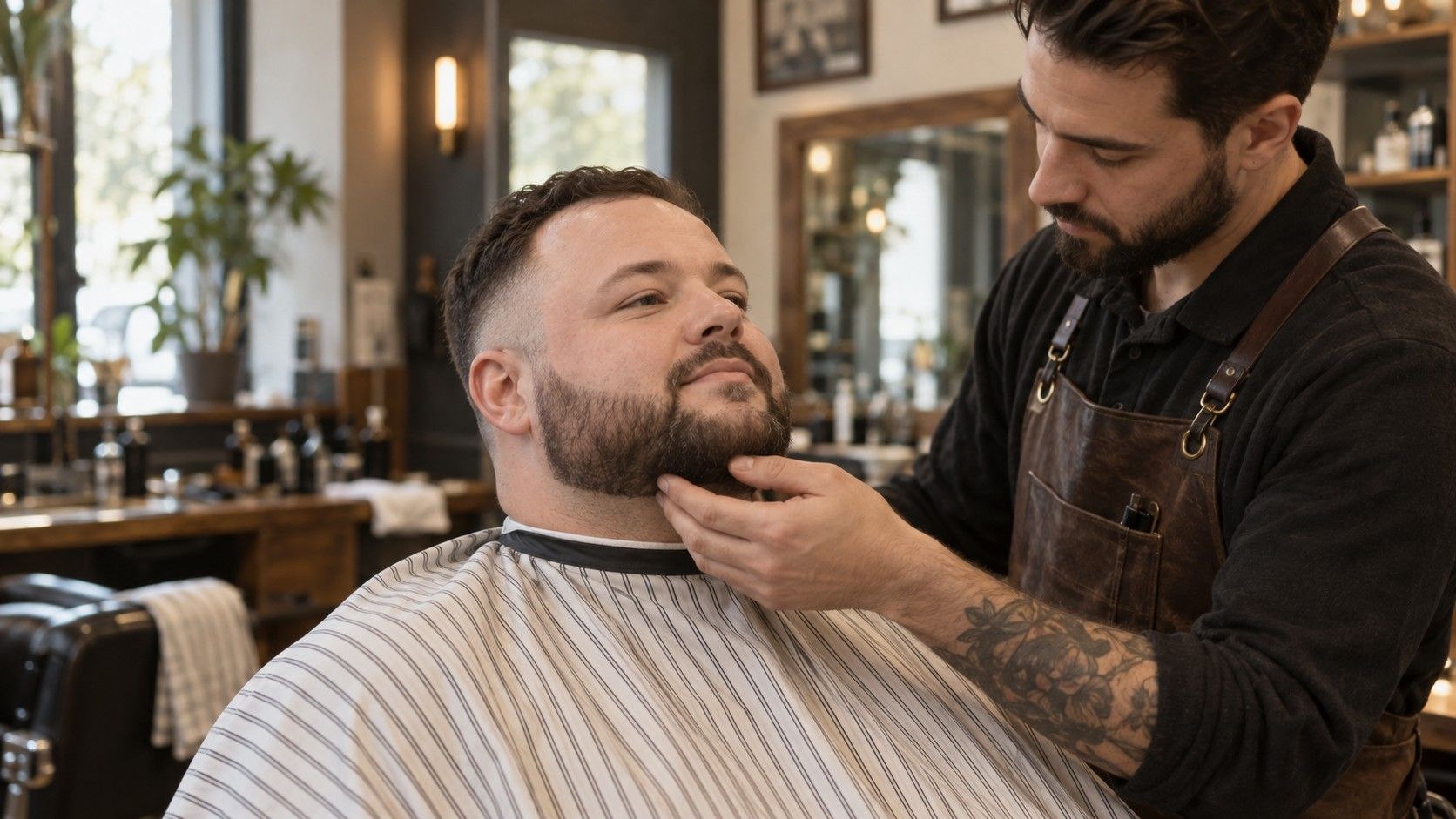
A beard adds a second outline around the lower face, and small changes at the cheeks, chin and sideburns can alter that outline considerably. Choosing beard styles for a round face is easier when you begin with your growth pattern and the finish you want to maintain. A short rounded beard, a fuller chin or close stubble can all be deliberate choices; none has to serve as a correction to your face.
Map where your beard actually grows
Look at the beard dry, in ordinary light, from the front and each side. Notice the natural cheek boundary, the density beside the mouth and the direction of the hair under the jaw. Do this before trimming everything down to one length. A sparse upper cheek and a dense chin can support a different outline from evenly distributed growth, even if the faces underneath look similar.
Longer hair can overlap some gaps, but it does not guarantee a continuous beard. Check whether the hair lies across an open area or simply grows away from it. Let your own pattern guide the options: a lower natural cheek line, defined stubble, a moustache with shorter cheeks or a beard with more weight at the chin. Avoid choosing a reference whose main feature depends on density you do not currently have.
Texture affects the apparent length too. Curly beard hair may form a compact outline while straight hair of the same stretched length hangs lower. Brush or comb it in the direction you normally wear it before judging the shape. If you compare pictures, match texture and density where possible, and separate what you like about the photograph from what you can reproduce comfortably.
Set cheek and neck lines while standing naturally
The cheek line can follow the natural upper boundary, be lightly tidied or sit lower with a deliberate edge. Start by removing isolated hairs above the main growth rather than immediately carving a deep curve. Lowering the line changes the amount of visible beard on the cheek and can be difficult to reverse quickly. A small amount taken off each side is easier to assess than a dramatic first pass.
For the neckline, check your head in its normal upright position. Looking far up stretches the skin and can make a line seem lower than it will appear when you relax. Use a mirror to inspect the underside, then return to a level gaze before making the final decision. A line cut too high can leave an exposed strip under the jaw; one left lower can give a fuller base. Decide which outline you want rather than following an exact finger-width formula.
A barber can help establish the first boundary if you have trouble seeing it. Ask them to show where the line sits with your head neutral and explain how to maintain it at home. A crisp shaved edge requires more frequent upkeep than a softly trimmed one. The most precise outline is not necessarily the most comfortable choice, particularly if close shaving tends to irritate your skin.
Symmetry is useful as a check, but natural growth and facial features are rarely perfectly mirrored. Work from the overall appearance rather than repeatedly lowering the stronger side to chase a weak patch on the other. Put the trimmer down, step back from the mirror and check again. Very close inspection can encourage you to remove more than the shape needs.
Compare chin length with width at the sides
Leaving the chin longer than the cheeks creates a different outline from keeping the beard evenly rounded. If you want that direction, build the difference gradually. A little additional length at the centre can already change the profile; a sharply pointed chin is a separate, stronger choice. Look from the side to make sure the underside connects as intended rather than forming an unexpected shelf.
Keeping the cheeks shorter can make the chin look more prominent by comparison. It can also reveal sparse areas that were less noticeable under longer overlapping hair. Do a conservative first trim and brush the beard back into place before deciding whether to go shorter. Hair that bends outward at the jaw may need selective adjustment rather than reducing the entire side to a lower guard.
| Outline to consider | How it is usually built | Useful check |
|---|---|---|
| Even short beard | Similar visible length across cheeks and chin | Whether different growth directions make one area look longer |
| Fuller chin, shorter sides | A gradual length change toward the centre | The side profile and density beside the mouth |
| Soft rounded beard | A curved perimeter with restrained corners | Whether the lower edge stays balanced when dry |
| Defined stubble | Short growth with a chosen cheek and neck boundary | Comfort and the amount of edge upkeep required |
A square or angular lower edge is possible when the growth supports it, but the corners need enough hair to hold their form. Do not cut a hollow into the sides simply to suggest a sharper jaw. If you prefer softness, preserve a curved edge and concentrate on stray hairs. A round face can wear a rounded beard; the result does not need to imitate a different bone structure.
Connect sideburns, haircut and moustache deliberately
Sideburns link the hair on the head with the beard. A gradual transition can keep that connection soft, while an abrupt change creates visible contrast. If your haircut has a fade, tell the barber whether you want the beard blended into it or left clearly separate. Check the temple with glasses on if you wear them, since the frame can hide part of the transition during the appointment.
Do not automatically use the same guard on the sideburns and cheeks. Different density and growth direction can make equal lengths appear uneven. Begin longer, compare the result and reduce gradually if needed. When you visit a barber for the haircut and maintain the beard yourself, photograph the transition before it grows out so you have a useful reference for the next trim.
The moustache changes the upper edge of the beard frame. You may prefer it integrated into the beard, clearly separated or shorter for comfort around the mouth. Check it with your lips relaxed. Pulling the mouth tight while cutting can shift the apparent edge. Trim conservatively and keep the tool away from the lip itself, following the manufacturer's instructions for the attachment you use.
If the connectors beside the mouth are light, there is no need to make them look artificially dense. A moustache and chin beard can remain visually separate, or the surrounding beard can be kept shorter so the contrast feels intentional. Choose an arrangement you like in normal conversation distance, not only in a magnifying mirror.
Keep the outline comfortable between trims
Trim clean, dry hair when practical so its length and direction are easier to judge. Start with a longer guard than you think you need and make small changes. Brush the beard between passes; bent hairs may settle into place without further cutting. Clean the tool as instructed and avoid repeatedly scraping an area to obtain an edge your skin finds uncomfortable.
Wash and dry the beard in a way that suits your skin, and use a small amount of a tolerated conditioning product if it helps the hair feel manageable. Oil or balm can change feel and hold, but it does not create growth in a sparse area. Strong fragrance and heavy product are optional. If something causes discomfort, stop using it rather than treating irritation as a necessary part of maintaining the style.
Plan upkeep around the feature you notice first. Stubble may lose its chosen length quickly, a crisp neckline may become fuzzy, and a fuller beard may mainly need occasional perimeter work. The timing varies with growth and your preference. Keep one photograph immediately after a successful trim and another just before the next one. Together they show whether you want a tighter cheek, a softer neck boundary or more room at the chin.
When changing styles, preserve useful length until the new outline is clear. Moving from a rounded beard to a longer chin usually means allowing growth before refining the edge, whereas reducing a long beard can be done in stages. Ask for a pause after the first reduction and view the profile. You can remove another small amount during the same appointment; rebuilding an overtrimmed section takes time.