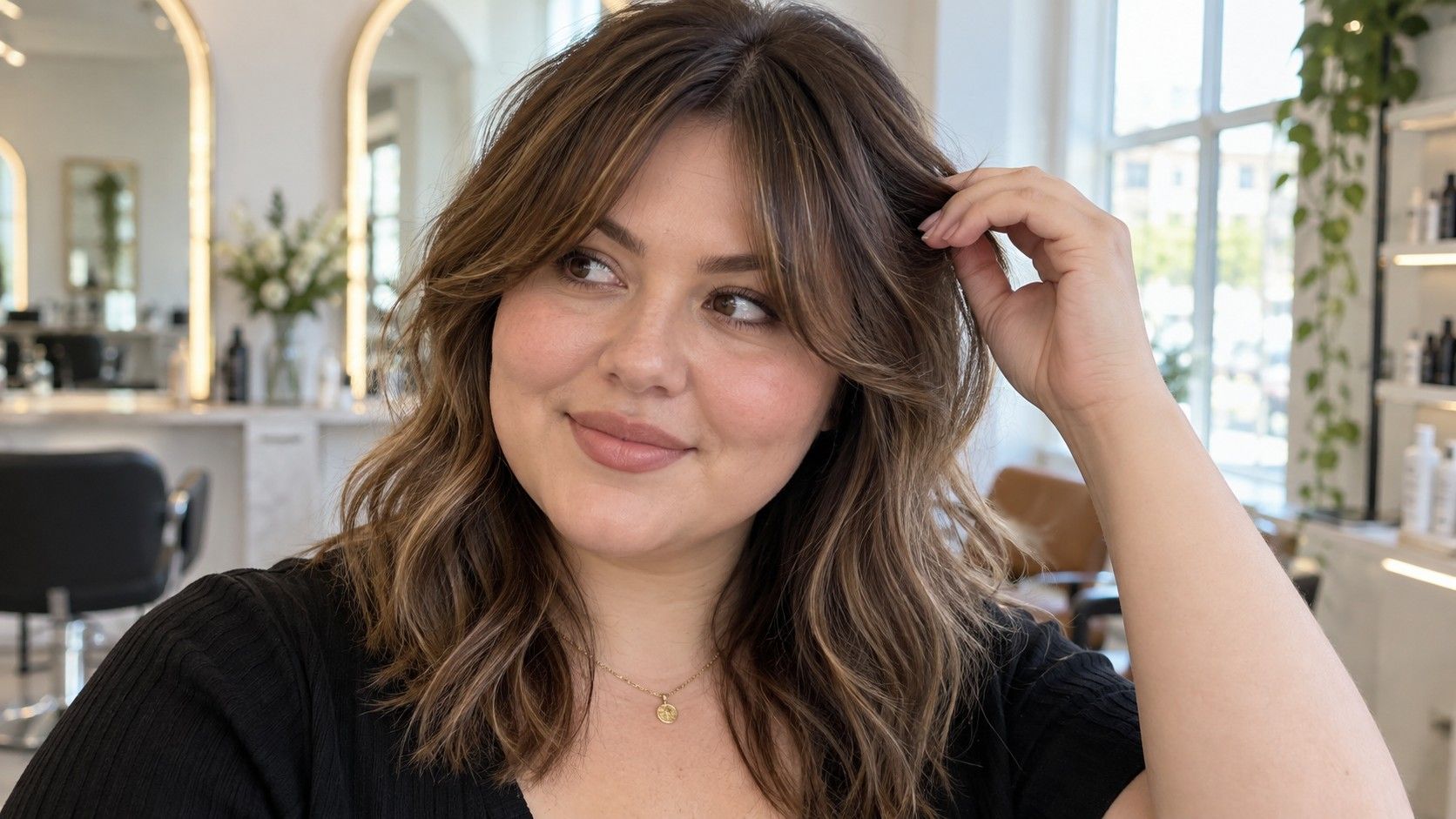
A bob can sit at the cheek, follow the jaw or brush the collarbone, and those few inches change how the whole cut feels. Choosing a bob for a round face starts with where you want the outline to land and how your own hair behaves there. The shape of your face supplies context; your preferred silhouette, natural texture and willingness to style it supply the useful instructions for the haircut.
Find the endpoint you want to see every morning
Before collecting haircut names, fold the ends of your hair under and hold them at three levels: just below the ears, at the jaw and a little below the chin. Look straight ahead, then turn sideways. A short line can put attention on the cheeks; a lower line leaves more space between the widest part of the face and the perimeter of the hair. Neither result needs correcting. Decide which outline you enjoy, then use that endpoint as the starting reference.
Photographs help when they show comparable hair. A smooth jaw-length bob on dense straight hair may look very different from the same nominal length on loose curls. Choose one picture for the length and another for the texture if necessary. Tell the stylist exactly which feature you mean in each. Asking for the whole photograph can accidentally include a heavy fringe, a hidden undercut or a polished finish you never intended to maintain.
The chin is a moving landmark. A cut that seems comfortably below it with your head tilted down may sit beside it when you stand naturally. Check the proposed length upright, with shoulders relaxed. If you want to tuck the front behind your ears, have the stylist check whether the shortest pieces will actually reach. If tying the hair back matters, a bob that clears the jaw may still leave the nape and front too short for a small ponytail.
Choose a perimeter before deciding on layers
A blunt bob keeps the ends at a relatively solid line. That can make fine hair look more substantial at the perimeter, though the result still depends on density and styling. An airy, layered bob breaks up that line and changes where volume sits. Layering is not automatically lighter in every useful sense: short layers can spring outward, especially when waves gather at cheek level. Ask where the shortest layer will finish on dry hair.
A graduated bob is another specific construction, usually with shorter hair behind and a longer outline toward the front. It can give lift at the back without requiring the front to be equally short. The angle may be subtle or pronounced. A dramatic forward slope has a strong profile, but it also makes uneven growth and imperfect styling more visible. Look at the back of the reference as carefully as the front.
| If your priority is... | Discuss this option | Check before cutting |
|---|---|---|
| A visible, substantial edge | A blunt or lightly softened perimeter | Whether the ends become bulky at your chosen length |
| Movement through waves | Selected longer layers | Where the waves rebound when dry |
| Less weight at the nape | Gentle graduation | The back view and the shape between trims |
| An easy tied-back option | A longer bob with restrained front layers | Whether the nape and side sections reach the tie |
Internal weight removal and visible layers are different requests. Thick hair may need weight reduced inside the cut while keeping a strong outer edge. Fine hair may lose the outline you wanted if too much is removed. Rather than asking vaguely for “lots of texture,” describe the problem: the sides puff out, the back feels heavy, or the ends collapse. That gives the stylist something observable to solve.
Make the front work with your part and your habits
The front pieces often matter more to the everyday impression than the length at the back. A centre part gives a fairly balanced frame; an off-centre or side part changes how much hair falls on each side. Try both with your existing hair before the appointment. If your part naturally returns to the same place after washing, ask for a cut that accommodates it instead of relying on a new part that needs coaxing every day.
Longer pieces toward the front can form a diagonal beside the cheeks. Shorter face-framing pieces can open the eye and cheek area. Those are visual choices, not rules about which face deserves which cut. If you wear glasses, check the front with the frames on. A section that looks graceful when loose may catch behind a temple arm or flip outward after repeated tucking.
Tell the stylist how often your hair is pushed behind the ears, clipped away for work or pulled back for exercise. A front section that only looks right hanging freely will be frustrating if you rarely leave it there. Ask to see the bob tucked as well as untucked before the final detailing. Tiny adjustments to the front can be easier to judge after the hair is dry and arranged in your normal part.
Allow waves, curls and density to change the outline
For wavy hair, the proposed endpoint may coincide with a bend that kicks out or curves in. Wet length alone cannot show that reliably. Arrive with a useful account of your wash-day hair, and show a photograph taken without a blowout if the consultation happens with your hair styled. A dry check helps reveal whether the sides gather into a broad shelf or fall in separate sections.
Curly bobs need room for shrinkage and for variation between curl groups. A tighter section at the temple may sit higher than a looser section at the nape even when both were stretched to the same length. Discuss the shape in its dry state and how much difference you see between wash day and the following days. There is no dependable universal allowance in inches; the relevant reference is your own curl pattern and routine.
Dense hair and fine strands can occur together, so “fine” does not necessarily mean sparse or flat. Explain both strand feel and the amount of hair. A heavy triangular outline might need selective weight removal, while a thin perimeter might need fewer layers. If you alternate between natural texture and straight styling, mention both finishes. A cut designed for one can look unexpectedly stepped or broad in the other.
Test the maintenance before committing to the shortest version
A bob exposes the ends, so the finish has a large effect on its appearance. Ask the stylist to demonstrate a routine with the tools you actually own. A round-brush blowout, a diffuser and air-drying produce different results. If the reference has a smooth curve underneath, find out whether that curve comes from the cut, the hair's natural bend or several minutes of brush work on each side.
Notice the nape after sleeping and the front after wearing headphones or a hat. Short hair can take less time to wash but still need a reset in particular areas. Before choosing a close nape, consider whether you are comfortable rewetting and drying it on busy mornings. Product can help hold a finish, but it will not make every growth direction disappear. Use heated tools according to their instructions and a temperature suited to your hair rather than repeatedly passing over one stubborn section.
Discuss the next trim as part of the first appointment. A very precise outline may need attention sooner than a softer, longer bob, but the timing depends on growth and your tolerance for the changing shape. Ask what the haircut will look like after several weeks and which areas will lose their shape first. That answer is more useful than a rigid schedule detached from your routine.
If the choice still feels uncertain, keep the first cut slightly longer than the shortest reference. Wear it through washing, sleeping, work and an ordinary day outside before deciding whether to go shorter. At a follow-up, bring a photo of what bothered you: a flipped end, excess side volume or a front piece that will not tuck. “This corner catches on my glasses” is a clearer request than “make it more flattering.”